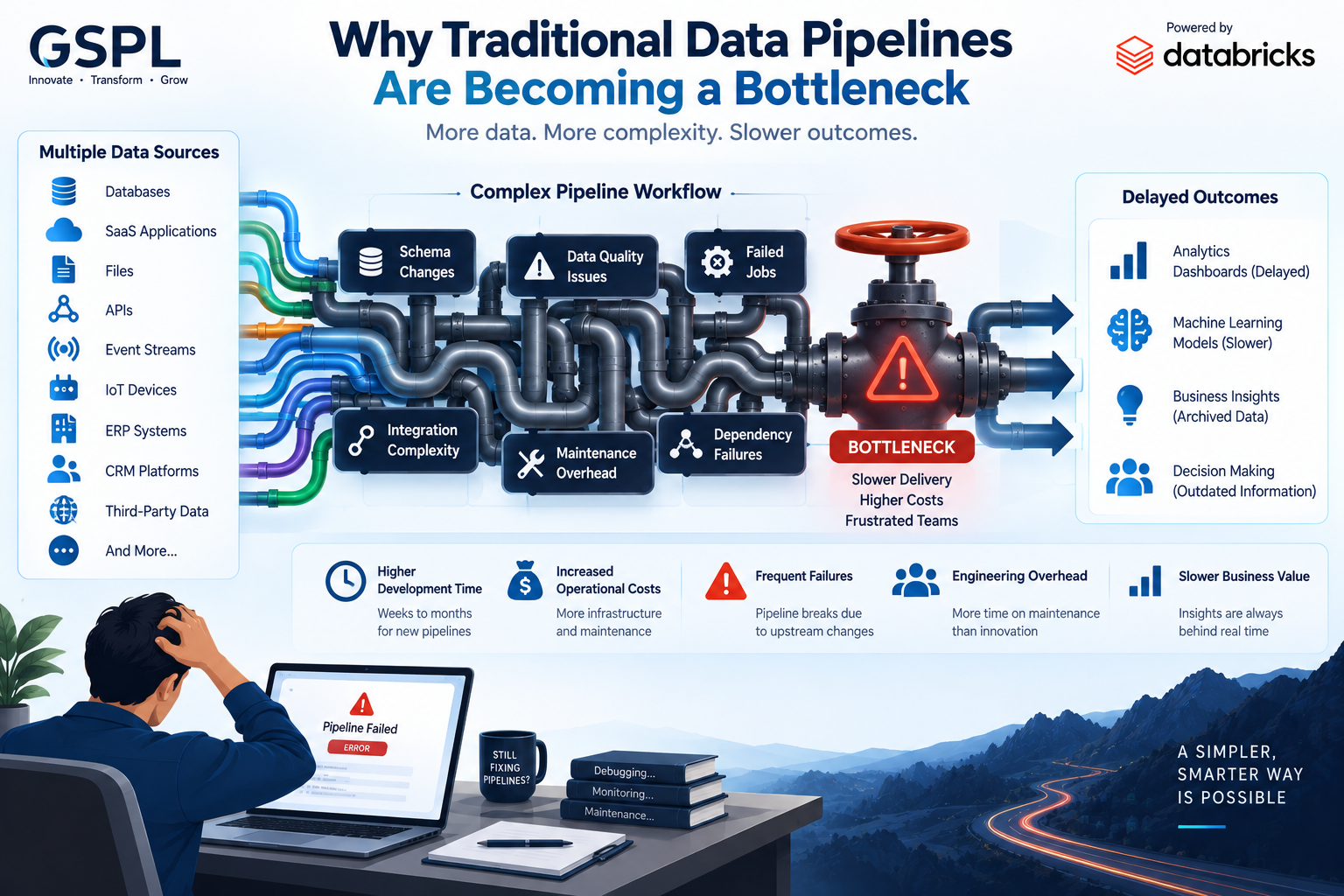
Enterprise data infrastructure is experiencing a structural inflection point. Traditional ETL/ELT pipeline architectures, designed for predictable batch workloads and stable source systems, are increasingly unable to meet the operational demands of modern data-intensive organizations. As source diversity expands, business velocity accelerates, and analytical requirements grow more sophisticated, pipeline complexity is consuming engineering resources at rates that undermine strategic data initiatives.
Executive Summary
- •The problem: Data engineering teams are spending 40-60% of their time on pipeline maintenance, troubleshooting, and operational firefighting rather than building strategic data capabilities or enabling business value.
- •Root causes: Exponential growth in data sources, schema volatility, fragmented tooling, insufficient observability, and the widening gap between business velocity and engineering throughput.
- •Business impact: Delayed insights, missed market opportunities, reduced data quality, higher operational costs, and engineering talent retention challenges as teams become trapped in maintenance cycles.
- •The shift: Organizations are moving toward AI-assisted data engineering platforms that automate discovery, generation, validation, and troubleshooting — enabling engineers to focus on architecture, governance, and strategic initiatives rather than repetitive implementation.
The Operational Reality of Modern Data Pipelines
Traditional data pipeline architectures were designed for environments where data sources numbered in the dozens, schemas remained relatively stable, and business requirements evolved on quarterly planning cycles. Engineers could manually write transformation logic, establish fixed schedules, and respond to occasional failures through manual intervention.
Today's enterprise data environments bear little resemblance to that model. Organizations routinely integrate hundreds or thousands of data sources spanning SaaS applications (Salesforce, Workday, ServiceNow), cloud databases (RDS, Aurora, Snowflake), APIs (REST, GraphQL, webhooks), event streams (Kafka, Kinesis, Pub/Sub), IoT telemetry, mobile applications, and third-party data providers.
Simultaneously, business expectations have fundamentally changed. Stakeholders expect data to be available within hours rather than days, support real-time operational dashboards, enable machine learning model training, and power generative AI applications. The latency tolerance for analytical insights has compressed dramatically while the complexity of data processing has increased proportionally.
The result is a growing disconnect: pipeline complexity and maintenance burden are scaling faster than engineering capacity to manage them.
Complexity Compounds With Every Integration
Adding a new data source appears deceptively simple in architectural diagrams. In production implementation, each integration introduces substantial engineering overhead that extends far beyond the initial connection.
Consider a typical enterprise data source integration:
- Schema discovery and mapping: Engineers must understand source schemas, identify primary keys, map foreign key relationships, and determine appropriate target data models.
- Authentication and authorization: Implement OAuth flows, API keys, service principals, or certificate-based authentication while respecting least-privilege access principles.
- Incremental ingestion logic: Develop change data capture mechanisms, watermarking strategies, or timestamp-based extraction to avoid full table scans.
- Schema evolution handling: Build resilience to schema changes including new columns, dropped fields, data type modifications, and structural refactoring.
- Data validation: Implement quality checks for null values, data type correctness, referential integrity, business rule compliance, and anomaly detection.
- Error handling and retry logic: Manage transient failures, rate limiting, network interruptions, and source system unavailability with appropriate backoff strategies.
- Performance optimization: Tune parallelization, batch sizing, network throughput, and resource allocation to meet SLA requirements.
- Monitoring and alerting: Configure observability for pipeline health, data freshness, record volumes, error rates, and latency metrics.
This engineering investment must be repeated for each data source. As source counts grow from dozens to hundreds, the cumulative maintenance burden becomes unsustainable for traditional manual development approaches.
The Hidden Cost of Pipeline Maintenance
Production data pipelines require continuous operational attention. Industry surveys consistently show that data engineering teams allocate 40-60% of their capacity to maintenance activities rather than new capability development.
Pipeline failures occur for numerous reasons, many of which are outside direct engineering control:
- Schema evolution: Source systems add, remove, or modify fields without coordination with downstream data consumers.
- Data quality degradation: Upstream applications introduce malformed records, null values, or constraint violations that break transformation logic.
- Authentication failures: API tokens expire, credentials rotate, or access permissions change without notification.
- Infrastructure issues: Network latency, compute resource exhaustion, storage limits, or cloud service interruptions disrupt processing.
- Dependency failures: Upstream pipelines fail or deliver data late, cascading delays through dependent downstream processes.
- Performance degradation: Source data volumes grow beyond initial design assumptions, causing timeouts or resource constraints.
- Business logic changes: Stakeholder requirements evolve, requiring transformation logic updates that must be carefully validated.
When failures occur, resolution follows a time-intensive manual process: log investigation, dependency tracing, root cause identification, code modification, testing, and redeployment. For organizations operating hundreds or thousands of pipelines, this operational burden can consume the majority of available engineering time, leaving limited capacity for strategic initiatives.
Data Quality: The Silent Reliability Crisis
Pipeline execution success does not guarantee data correctness. This disconnect creates one of the most insidious challenges in modern data engineering: technical success metrics can mask business logic failures.
A pipeline can report successful completion while simultaneously producing:
- Missing records: Incomplete data extraction due to pagination errors, filtering mistakes, or query logic defects.
- Duplicate data: Improper deduplication logic causing inflated metrics and incorrect aggregations.
- Incorrect joins: Faulty join conditions producing cross products, incomplete matches, or wrong key relationships.
- Invalid calculations: Transformation errors in business logic, unit conversions, currency handling, or time zone adjustments.
- Stale data: Refresh failures or scheduling problems causing reports to show outdated information without clear indicators.
- Schema mismatches: Type coercion errors, truncation, or precision loss during data movement across systems.
These quality issues often remain undetected until business stakeholders identify discrepancies in reports, dashboards, or analytical outputs — by which point incorrect data may have influenced business decisions, degraded ML model accuracy, or undermined stakeholder confidence in the data platform.
Addressing this requires comprehensive data quality frameworks including automated validation checks, anomaly detection, business rule enforcement, and observability platforms that monitor data correctness alongside pipeline execution metrics. However, implementing and maintaining these quality controls adds further complexity to already overburdened engineering teams.
The Business Velocity Mismatch
A critical bottleneck emerges from the misalignment between business request velocity and engineering implementation throughput. Modern businesses operate at accelerated decision-making speeds that traditional data engineering workflows struggle to support.
Common scenarios include:
- Finance teams requiring new revenue attribution metrics for quarterly planning cycles
- Marketing teams needing customer segmentation for campaign targeting with tight launch deadlines
- Product teams requesting usage analytics for feature prioritization decisions
- Data science teams needing curated training datasets for ML model development
- Executive teams seeking custom KPIs for board presentations or investor relations
Each request enters an engineering workflow involving requirement gathering, technical design, development, testing, peer review, deployment, and validation. While this rigor ensures production quality, it creates latency that can span weeks or months for complex requirements.
The cumulative effect is a growing backlog of data requests, increasing shadow IT risk as business teams seek workarounds, and declining confidence in the data organization's ability to support strategic initiatives at the pace the business demands.
Volume Without Value: The Engineering Trap
Organizations are collecting unprecedented data volumes. However, data volume growth does not automatically translate to business value creation.
When engineering teams allocate the majority of their time to maintaining existing pipelines, troubleshooting operational issues, and performing repetitive manual transformations, limited capacity remains for activities that drive strategic business outcomes:
- Data architecture evolution: Designing scalable lakehouse patterns, implementing medallion architectures, and establishing domain-driven data modeling approaches.
- Governance frameworks: Building access controls, data classification systems, lineage tracking, and compliance capabilities required for regulatory alignment.
- Quality automation: Implementing comprehensive validation frameworks, anomaly detection systems, and observability platforms.
- Performance optimization: Tuning query performance, optimizing storage layouts, implementing caching strategies, and reducing infrastructure costs.
- Advanced analytics enablement: Building feature stores, real-time inference pipelines, ML model monitoring, and AI application infrastructure.
- Business collaboration: Understanding stakeholder needs, translating requirements, validating outputs, and ensuring data products deliver measurable value.
This resource allocation problem creates a paradox: organizations invest heavily in data infrastructure while simultaneously underutilizing their data engineering talent on high-value strategic initiatives. The pipeline maintenance burden effectively traps teams in operational cycles that prevent them from delivering transformational business impact.
The Emerging Solution: AI-Assisted Data Engineering
The limitations of traditional manual pipeline development are driving adoption of AI-assisted data engineering platforms. Rather than requiring engineers to manually perform every implementation step, these platforms integrate AI capabilities for automated data discovery, transformation generation, pipeline execution, error analysis, and performance optimization.
This represents a fundamental shift in the engineering model:
| Dimension | Traditional Manual Approach | AI-Assisted Approach |
|---|---|---|
| Data Discovery | Manual catalog search, documentation review | AI-powered semantic search and recommendation |
| Code Development | Write SQL/Python from scratch | AI-generated transformations from intent |
| Error Resolution | Manual log analysis and debugging | Automated root cause analysis and fixes |
| Optimization | Manual performance tuning, trial and error | AI-recommended improvements based on telemetry |
| Time to Production | Weeks to months | Days to weeks |
| Engineer Focus | Implementation and maintenance | Architecture, governance, strategy |
Critically, AI-assisted platforms do not eliminate the need for engineering expertise. Engineers remain responsible for validating business logic, ensuring governance compliance, reviewing AI-generated code, and making architectural decisions. However, AI handles the repetitive, time-consuming implementation details that currently consume the majority of engineering capacity.
Platforms such as Databricks Genie Code Agent exemplify this approach — providing agentic AI capabilities that assist with data discovery, pipeline generation, execution, validation, and troubleshooting within enterprise lakehouse environments while maintaining the governance, security, and audit controls required for production systems.
Conclusion: Toward Intelligent Data Operations
Traditional data pipeline architectures are experiencing structural limitations that cannot be resolved through incremental tooling improvements or additional headcount. The exponential growth in data sources, schema volatility, business velocity, and operational complexity requires a fundamental rethinking of how data engineering work is performed.
AI-assisted data engineering platforms represent this evolution — not by replacing engineers, but by automating the repetitive implementation and maintenance tasks that currently prevent teams from focusing on strategic initiatives. The objective is to redirect engineering capacity from operational firefighting toward architecture, governance, optimization, and business value delivery.
Organizations that successfully navigate this transition will achieve faster time-to-insight, higher engineering productivity, improved data quality, and the operational scalability required to support modern data-intensive businesses.
Ready to Move Beyond Pipeline Bottlenecks?
G S Pvt Ltd helps organizations modernize data engineering with intelligent workflows, AI-assisted development, and scalable lakehouse architectures — from assessment and strategy to implementation and team enablement.
Schedule a Consultation →