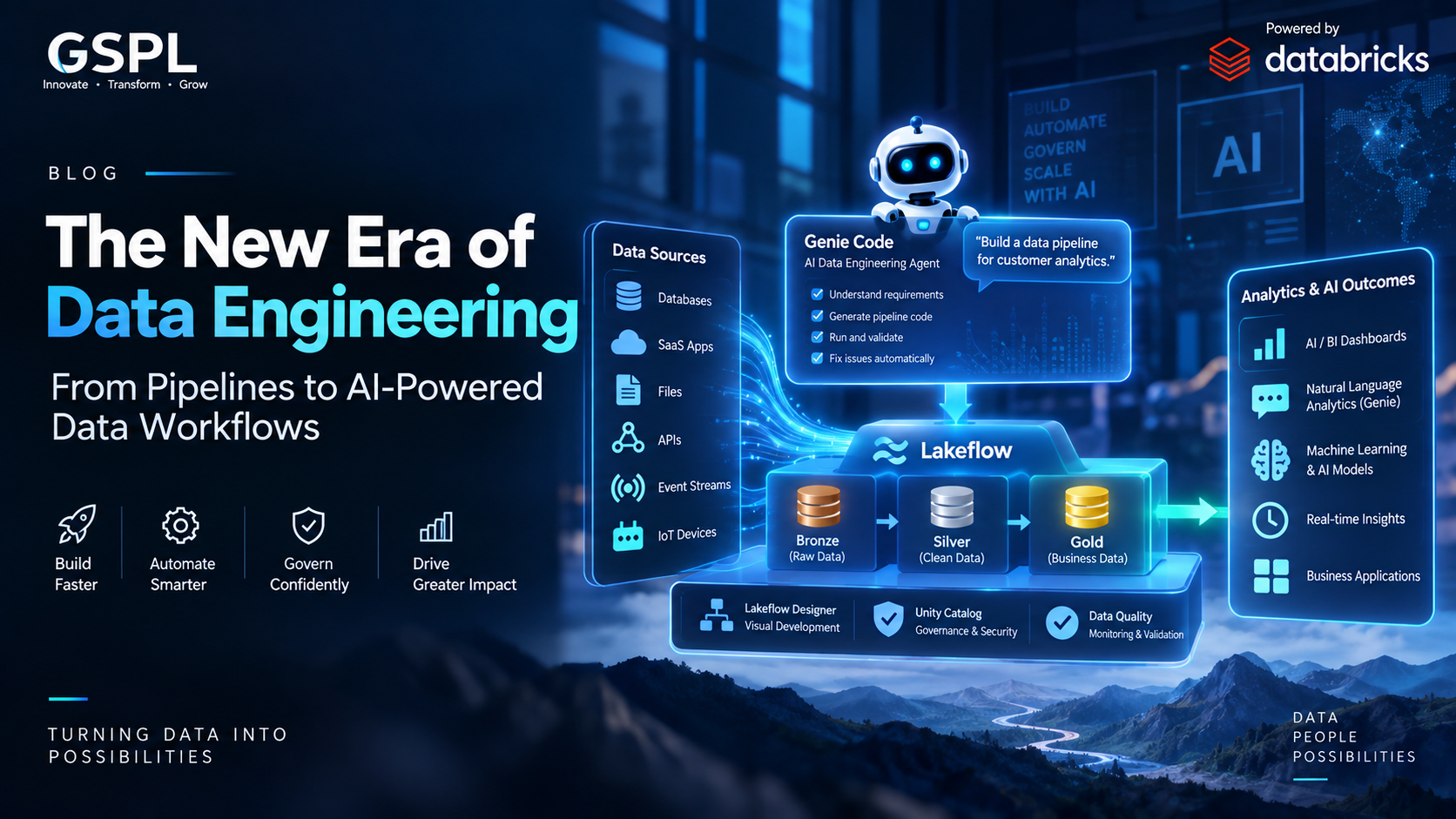
Enterprise data engineering is undergoing a fundamental transformation. As data volumes and business expectations accelerate, traditional manual pipeline development is reaching operational limits. Leading platforms now integrate agentic AI directly into the engineering lifecycle, enabling intent-driven development and intelligent automation across lakehouse architectures.
Executive Summary
- •The shift: AI agents now assist with data discovery, transformation generation, pipeline execution, and automated troubleshooting — moving from manual coding to intent-driven workflows.
- •Platform example: Databricks Genie Code Agent represents this evolution, handling multi-step workflows from dataset discovery to error resolution within lakehouse architectures.
- •Impact: Engineers focus on architecture, governance, and strategic data modeling while AI accelerates repetitive implementation tasks.
- •Requirements: Enterprise adoption requires robust access controls, code review workflows, data lineage, audit logging, and compliance alignment.
The Challenge With Traditional Pipeline Development
Data engineering has centered on building ETL/ELT pipelines that extract, transform, and load data into analytical stores. Engineers manually write SQL and Python transformations, configure orchestrators, monitor failures, and maintain infrastructure.
This worked when organizations had limited, stable data sources. Today, enterprises generate data continuously across hundreds of sources — cloud applications, databases, APIs, SaaS platforms, streaming events, IoT devices. Simultaneously, businesses demand near-real-time analytics, ML pipelines, and AI applications.
The core challenge: Teams must build increasingly complex systems without proportional growth in engineering effort, cost, or time-to-production.
- Volume and velocity: Petabyte-scale processing across batch, streaming, and interactive workloads.
- Schema complexity: Semi-structured JSON, nested arrays, evolving schemas requiring sophisticated parsing.
- Operational overhead: Manual monitoring, error investigation, and performance tuning that scales poorly.
- Skill scarcity: Distributed systems, cloud infrastructure, and domain expertise create talent challenges.
From Manual Pipelines to Intelligent Workflows
Traditional workflows are linear and manual: identify requirements, locate sources, write transformations, test, deploy, monitor, debug. Each step requires significant time and expertise.
AI-assisted workflows integrate automation at each stage. Instead of manually searching catalogs, engineers describe intent and receive dataset recommendations. Instead of writing code from scratch, they specify outputs and receive generated transformations. When pipelines fail, AI analyzes errors and suggests corrections.
Traditional Workflow
AI-Assisted Workflow
Engineers validate business logic, ensure quality standards, implement governance, review code, and approve deployments. AI handles repetitive implementation while engineers maintain architectural control.
Agentic AI: Multi-Step Engineering Workflows
The most significant advancement is agentic AI — systems that execute multi-step workflows autonomously rather than generating static code responses.
For example, given the objective: "Build a pipeline combining customer demographics with transactions to produce daily regional revenue by age group" — an agentic workflow can:
- Discover relevant datasets by searching catalog metadata
- Analyze schemas to identify join keys and required fields
- Generate SQL or PySpark transformation logic
- Execute the pipeline and validate results
- Troubleshoot errors and implement corrections
- Recommend performance optimizations
Databricks Genie Code Agent implements this model for lakehouse platforms, with integration into Unity Catalog (data discovery), Delta Lake (ACID transactions), and Spark (distributed processing) — maintaining lineage, governance, and audit logging for production environments.
Modern Architecture: AI as an Embedded Layer
Modern platforms adopt a layered model where AI operates between human intent and data infrastructure:
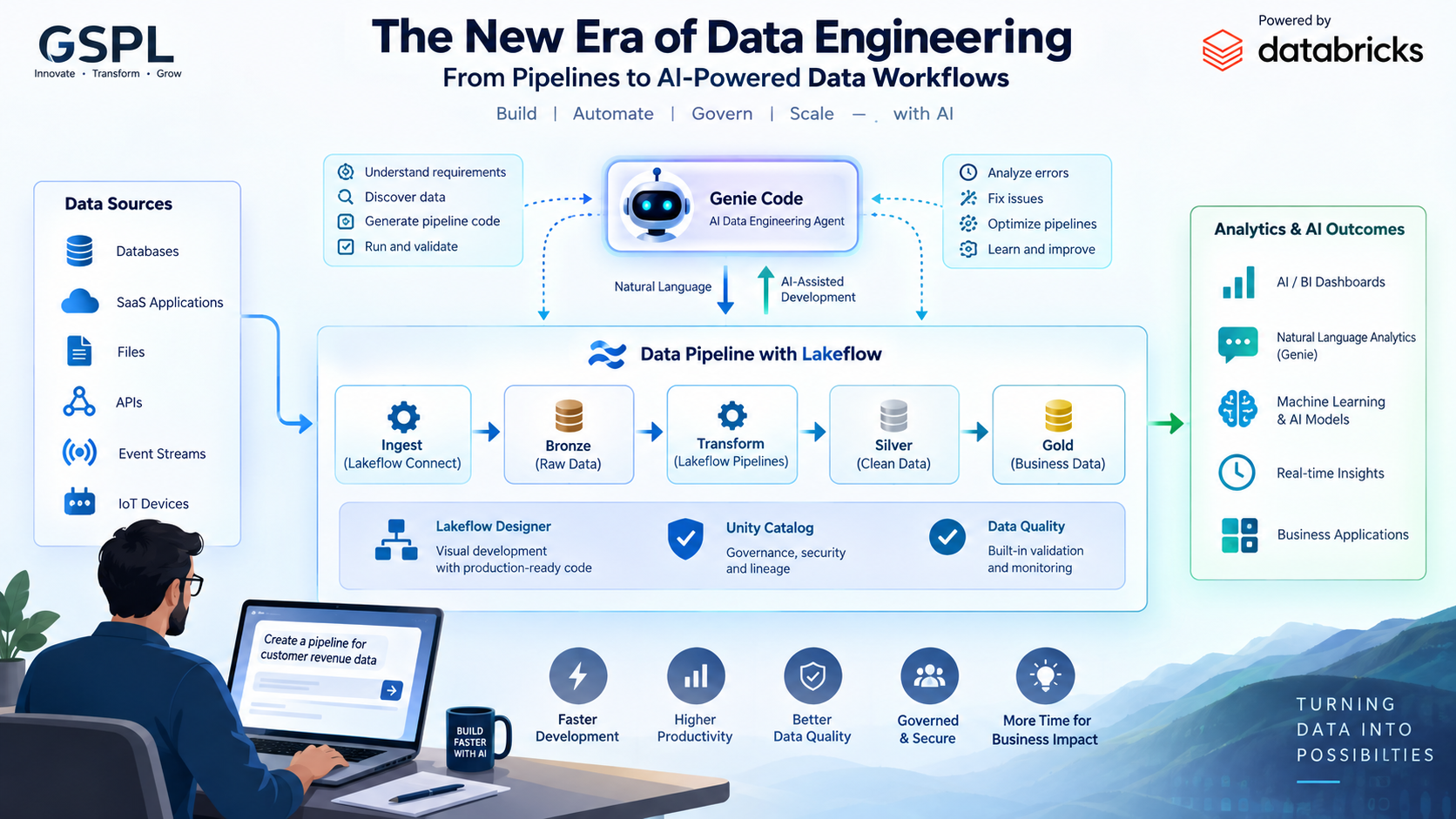
- Business Intent Layer: Engineers describe objectives rather than writing implementation code.
- AI Agent Layer: Discovers data, generates code, executes pipelines, analyzes results, troubleshoots failures.
- Data Platform: Lakehouse infrastructure provides ingestion, transformation, quality, governance (Bronze → Silver → Gold).
- Analytics & AI/ML: Dashboards, model training, real-time scoring, generative AI applications.
AI doesn't replace the platform — it works with it. The platform provides infrastructure, governance, security, and execution. AI accelerates how engineers interact with those systems.
Strategic Impact: What Changes for Teams
Engineering Focus Shifts
When AI handles repetitive implementation, engineering capacity redirects to higher-value activities:
- Data architecture design and domain modeling
- Governance, compliance, and security frameworks
- Data quality and observability platforms
- Business collaboration and requirements translation
- ML platform development and feature engineering
Evolving Skill Requirements
Still Essential
- ✓ SQL and PySpark proficiency
- ✓ Distributed systems understanding
- ✓ Cloud infrastructure knowledge
- ✓ Data modeling principles
Increasingly Important
- ★ Business requirements translation
- ★ AI-generated code evaluation
- ★ Governance policy implementation
- ★ Architectural decision-making
Governance and Enterprise Requirements
Enterprise adoption requires governance frameworks ensuring AI-generated pipelines meet security, compliance, and quality standards:
- Access control: AI inherits user permissions, respects data classification, maintains audit logs.
- Code review: Automated testing, peer review, security scanning, version control with AI-generation metadata.
- Data quality: Automated validation checks, monitoring integration, rollback capability.
- Compliance: GDPR/CCPA data residency, HIPAA encryption, SOC 2 controls, industry-specific regulations (PCI-DSS, FDA 21 CFR Part 11).
Conclusion: Intelligent Engineering
AI integration represents intelligent engineering — not automated engineering. AI handles repetitive implementation while engineers focus on architecture, governance, and strategy.
SQL, Python, and data modeling expertise remain essential. They're now complemented by evaluating AI solutions, implementing governance, and determining when human judgment is required.
Organizations adopting this model achieve faster time-to-value, higher productivity, improved quality, better business alignment, and scalable operations. However, success requires platform modernization, governance frameworks, team training, and integration with existing security and compliance requirements.
The goal isn't to eliminate data engineering — it's to make it more strategic, scalable, and aligned with business value.
Ready to Modernize Your Data Platform?
G S Pvt Ltd helps organizations build modern lakehouse architectures with AI-powered workflows — from strategy to implementation.
Schedule a Consultation →