Lakehouse Architecture for Generative AI: What Enterprises Need to Know
How the modern lakehouse is becoming the foundation for enterprise GenAI, RAG, AI agents, analytics, and governed AI applications.
Generative AI Needs a Strong Data Foundation
Generative AI has moved quickly from experimentation to enterprise adoption. Organizations are building AI assistants, RAG applications, enterprise search, AI agents, customer-support systems, document intelligence, automated analytics, and AI-powered business applications.
But there is a problem. A powerful foundation model alone does not give an organization useful enterprise AI. The model needs access to trusted, current, relevant, and governed enterprise data. This is where lakehouse architecture becomes increasingly important.
A modern lakehouse brings together the flexibility of a data lake with the reliability and analytical capabilities associated with data warehouses. For Generative AI, the lakehouse can become more than a place to store data—it can become the data foundation connecting enterprise information to AI models, retrieval systems, agents, and applications.
What Is Lakehouse Architecture?
Traditional data architecture often separated workloads. Analytics teams maintained data warehouses for BI, while ML teams operated separate data lakes for model training. Generative AI introduced another collection of technologies: document processing, embeddings, vector databases, and LLM applications.
This creates fragmented architectures. The lakehouse approach aims to bring these workloads closer together—creating a shared data foundation that can support different workloads while maintaining consistency and governance.
Why Generative AI Changes Data Architecture
Traditional analytics asks questions about known datasets. Generative AI introduces new requirements. An AI application may need to retrieve documents, search structured data, understand business context, combine information from multiple sources, pass relevant context to an LLM, generate a response, cite the source, and potentially take an action.
Consider an enterprise knowledge assistant that needs to search HR policies, product documentation, internal knowledge bases, customer records, operational databases, and data warehouse tables. A fragmented architecture makes this difficult. A lakehouse provides a common foundation for bringing these datasets together and governing how they are accessed.
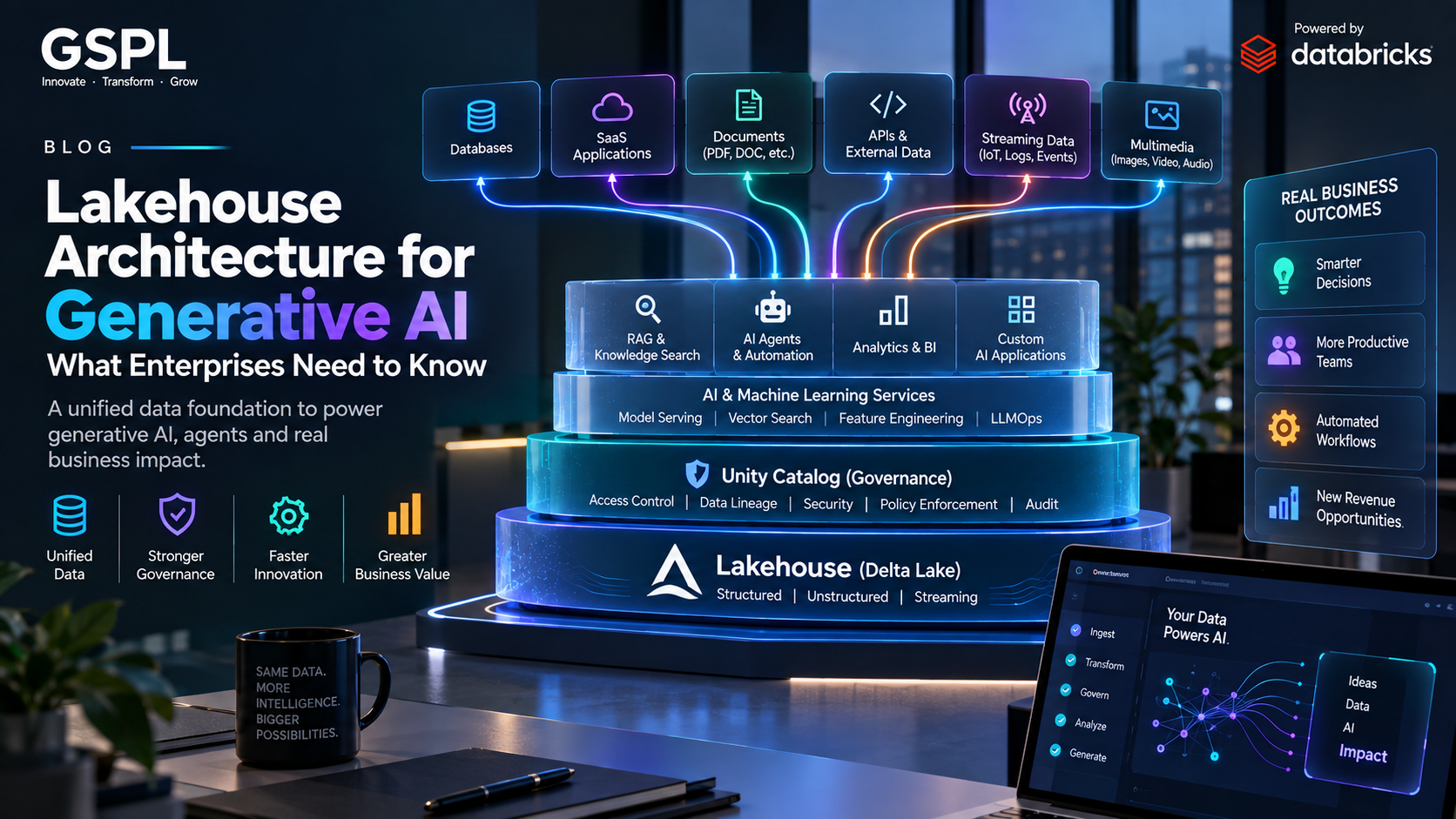
The Five Layers of a GenAI Lakehouse
1. Data Layer
This is where enterprise information originates: CRM systems, ERP systems, SaaS applications, databases, APIs, documents, PDFs, emails, logs, IoT systems, and streaming platforms. The objective is to bring relevant data into an environment where it can be processed, governed, and consumed.
2. Data Engineering Layer
Raw data is not automatically ready for AI. It needs to be cleaned, transformed, validated, enriched, deduplicated, standardized, joined, and versioned. A RAG application built on outdated or inconsistent information will not become reliable simply because it uses a better LLM. AI quality depends heavily on data quality.
3. AI and Retrieval Layer
This layer supports the components required by GenAI applications: embedding models, AI Search, vector indexes, RAG pipelines, foundation models, fine-tuned models, model serving, and AI agents. Databricks AI Search supports semantic and hybrid search over data stored in governed environments and can be used for RAG and other AI applications.
4. Application Layer
This is where users interact with AI: enterprise chatbots, knowledge assistants, customer-service applications, AI-powered analytics, agentic workflows, internal productivity tools, and AI-powered search. The application layer consumes the data and intelligence provided by the underlying platform.
5. Governance Layer
Governance sits across the entire architecture, controlling who can access data, which models can be used, which AI applications can access resources, what agents can do, what information can be retrieved, and how activity is audited. Databricks Unity Catalog provides unified governance for data and AI, including access control, lineage, auditing, and discovery.
Why Governance Is Critical for GenAI
Consider an enterprise containing public information, internal information, confidential information, PII, financial information, and customer information. An AI application cannot simply retrieve everything.
Imagine an employee asks: "Show me the salary information for the engineering team." The AI system needs to understand whether that user has permission to access the information. This is why governance must exist before retrieval and generation, not simply after the response.
RAG and the Lakehouse
One of the most common enterprise GenAI architectures is Retrieval-Augmented Generation. The basic workflow transforms a user question into a query embedding, performs search/retrieval, passes relevant enterprise data as context to an LLM, and generates an answer.
A lakehouse can provide the foundation underneath this process: enterprise documents flow through data processing into governed tables, which feed AI Search indexes that support retrieval for LLM applications. This approach reduces the need to create an entirely separate data environment specifically for GenAI.
Structured Data Matters Too
A common misconception is that GenAI primarily works with documents. Enterprise AI often needs structured information. Consider questions like "Which products generated the highest revenue in Q2?" or "Why did customer churn increase last quarter?"
Answering these questions could require combining customer data, product usage, support tickets, revenue information, and customer feedback. The architecture therefore needs to support both structured and unstructured information—one of the strongest arguments for a unified data foundation.
From RAG to Agentic AI
The lakehouse becomes even more important when organizations move from RAG applications to AI agents. While a traditional RAG application follows a simple question-search-retrieve-answer pattern, an agent can perform multiple steps: planning, querying data, searching documents, calling tools, analyzing results, validating, and taking action.
This creates new requirements for the data platform: trusted data, business context, secure access, tool connectivity, low-latency data, agent state, monitoring, and governance. Databricks' platform architecture increasingly connects these capabilities through technologies such as Unity Catalog, AI Search, and Lakebase.
Data Quality Becomes AI Quality
One of the most important principles for enterprise GenAI is: Garbage in, garbage out. But the impact is different with generative AI. A traditional analytical system may show an incorrect number. An LLM can produce a highly convincing explanation based on incorrect information.
This makes data quality even more important. A GenAI-ready data pipeline should consider completeness, accuracy, freshness, consistency, duplicate detection, schema changes, data lineage, and data ownership. The lakehouse should therefore be treated as part of the AI quality strategy.
The Importance of Business Context
Raw data is not enough. AI applications also need to understand the meaning behind the data. For example, "Revenue" could mean gross revenue, net revenue, recognized revenue, or recurring revenue. A GenAI application that does not understand these definitions can produce technically plausible but business-incorrect answers.
Modern lakehouse architectures therefore need a semantic and governance layer that captures business definitions, metrics, data ownership, relationships, domains, and policies. Databricks' Unity Catalog includes capabilities for governed business context through Domains, Metrics, and Glossary.
Common Mistakes Enterprises Should Avoid
1. Creating a Separate AI Data Silo
Moving every document into a separate vector database can create another disconnected data environment. Consider how AI retrieval can remain connected to governed enterprise data.
2. Ignoring Structured Data
Many business questions require SQL and analytical data, not just document retrieval.
3. Treating Governance as an Afterthought
Permissions should be applied before information reaches the AI context.
4. Focusing Only on the LLM
A better model cannot compensate for poor data, weak retrieval, or missing governance.
5. Building Without Evaluation
A successful demo does not guarantee production reliability.
6. Ignoring Operational Requirements
Enterprise AI applications may require state, memory, low-latency access, monitoring, and scalable serving.
How Enterprises Can Prepare Their Lakehouse for GenAI
Organizations do not need to rebuild their entire data platform overnight. A practical roadmap can start with the existing architecture:
- Inventory Enterprise Data — Identify structured data, documents, APIs, operational databases, and streaming sources
- Identify High-Value AI Use Cases — Start with specific problems like enterprise search or customer support
- Improve Data Quality — Establish reliable pipelines and clear ownership
- Implement Governance — Define access policies, data classifications, ownership, lineage, and audit requirements
- Build Retrieval — Implement AI Search or another appropriate retrieval architecture
- Connect Models — Introduce LLMs and model-serving infrastructure
- Evaluate — Measure accuracy, groundedness, retrieval quality, latency, and cost
- Add Agents — Once the foundation is reliable, introduce agentic workflows and tool calling
- Operationalize — Add monitoring, CI/CD, security controls, and production support
What Enterprises Should Remember
- •GenAI Is a Data Problem Too — The quality of AI applications depends heavily on the quality and accessibility of enterprise data
- •The Lakehouse Can Become the AI Foundation — A modern lakehouse can support data engineering, analytics, ML, RAG, and agentic workloads from a shared foundation
- •Retrieval Needs Governance — AI Search and RAG should operate within enterprise access policies
- •Structured and Unstructured Data Need to Work Together — Real enterprise questions often require both
- •AI Governance Is Expanding — As agents become more capable, governance must cover not only data access but models, tools, agents, and runtime behavior
- •Architecture Matters More Than the Model Alone — The best enterprise AI systems are built on reliable data pipelines, governed retrieval, strong evaluation, observability, and secure deployment
The Future of the Lakehouse
The lakehouse was originally designed to bring together the flexibility of data lakes and the reliability of data warehouses. Generative AI is expanding that mission. The modern lakehouse is increasingly becoming a foundation for data engineering, analytics, machine learning, generative AI, RAG, AI agents, operational AI applications, and governed enterprise intelligence.
The architecture is moving from simple data-to-analytics pipelines toward data-context-intelligence-agents-applications-business actions. This is a fundamental change. Enterprise AI does not live independently from the data platform—it depends on it.
Final Thoughts
Generative AI has made enterprise data architecture more important, not less. Organizations can adopt the most advanced LLM available, but without trusted data, governed access, high-quality retrieval, reliable pipelines, and production monitoring, the resulting AI application will struggle to deliver consistent business value.
A modern lakehouse provides an architectural foundation for solving these challenges. It can bring structured and unstructured data together, support analytics and AI workloads, provide governed retrieval, connect data with models, and create a foundation for increasingly agentic applications.
For organizations preparing for the next phase of enterprise AI, the question is no longer whether they need a strong data foundation. The question is whether their existing architecture is ready for AI.
Ready to Build an AI-Ready Data Foundation?
GSPL helps organizations modernize their data and AI platforms using lakehouse architecture, Databricks, data engineering, RAG, AI/ML, AI agents, analytics, and enterprise governance. Whether you are modernizing a legacy data platform, implementing RAG, preparing enterprise data for GenAI, or building AI agents, we can help design and implement a scalable, secure, and governed lakehouse architecture aligned with your business goals.