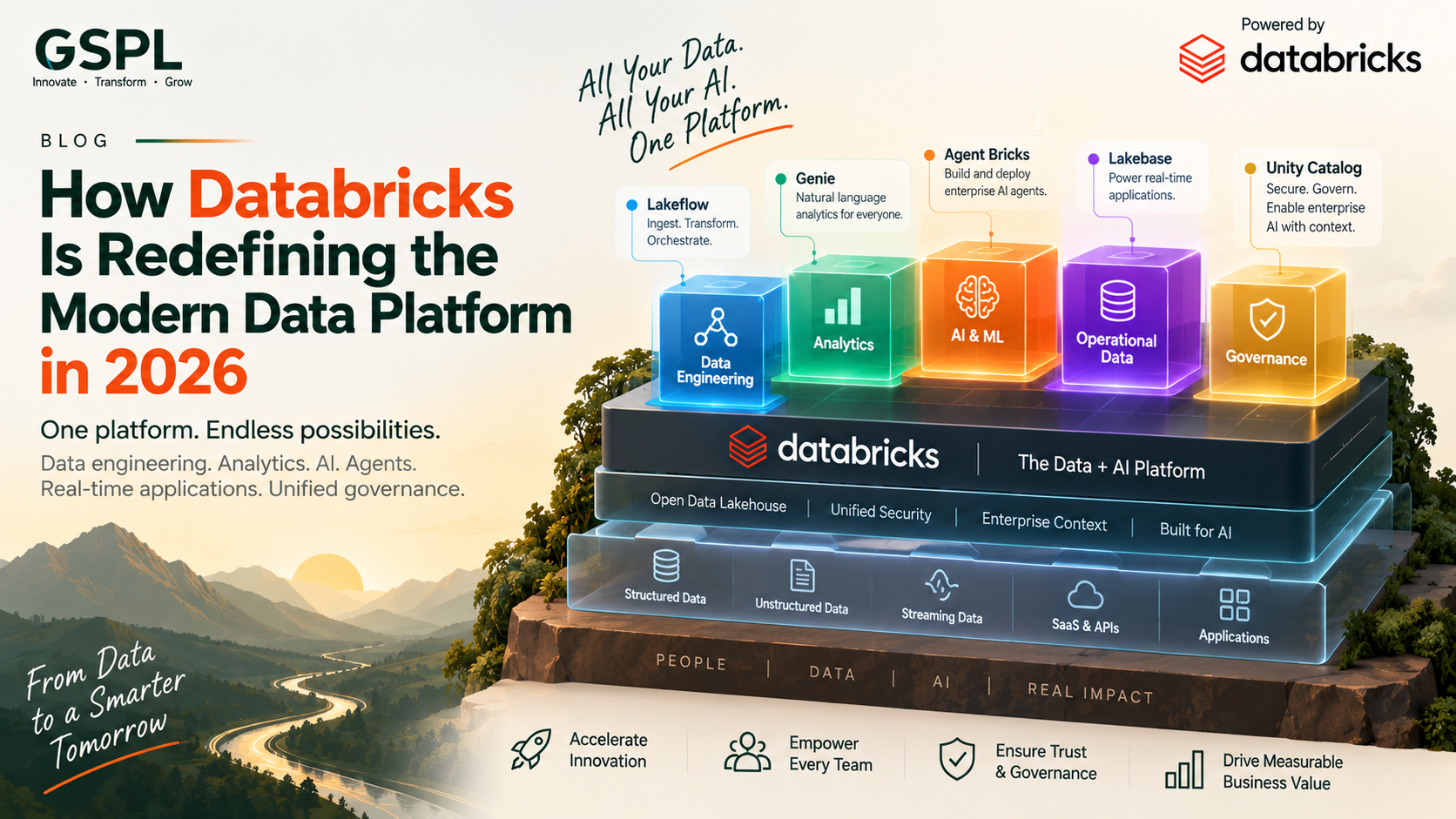
Enterprise data architecture is undergoing fundamental transformation. While organizations historically connected specialized platforms for warehousing, lakes, machine learning, BI, and governance, this fragmentation creates operational complexity, duplicated logic, and delayed insights. In 2026, Databricks is positioning its Data + AI Platform as a unified foundation bringing together data engineering, analytics, AI agents, governance, and operational workloads on a single governed infrastructure.
Executive Summary
- •Platform evolution: Databricks has evolved from Lakehouse (unified storage and analytics) to a comprehensive Data + AI Platform integrating data engineering (Lakeflow), analytics (Genie), AI agents (Agent Bricks), operational workloads (Lakebase), and unified governance (Unity Catalog).
- •Governance expansion: Unity Catalog is extending beyond data access control toward governing AI agents, models, tools, and MCP servers through Unity Gateway — addressing runtime agent behavior, cost controls, and approval workflows.
- •Business context: New capabilities including Domains (business-aligned asset organization) and Metrics (governed KPI definitions) provide semantic layer required for reliable AI reasoning over enterprise data.
- •AI-assisted workflows: Natural language interfaces (Genie, Lakeflow Designer) and agentic capabilities are moving data engineering and analytics from manual coding toward intent-driven development.
From Fragmented Systems to Unified Platform
Traditional enterprise data architecture required connecting specialized systems: data warehouses for analytics, data lakes for storage, separate ML platforms, BI tools, operational databases, and distinct governance layers. This created data silos, duplicated business logic, complex pipeline maintenance, and governance fragmentation.
Databricks' 2026 platform strategy addresses this fragmentation through unified infrastructure supporting data engineering, analytics, AI, and operational workloads on a single governed foundation. The architectural principle is straightforward: data and AI should not be separate platforms — they should work together.
Lakeflow: Modernizing Data Engineering
Data engineering remains foundational — if underlying data is incomplete, delayed, or poorly governed, analytics and AI inherit those problems. Lakeflow addresses the data engineering lifecycle including ingestion, transformation, and pipeline development.
Lakeflow Designer (generally available June 2026) provides visual, no-code transformation development through drag-and-drop interfaces, backed by production-ready code and Unity Catalog governance. It supports natural language interaction for building workflows.
This creates tiered development: data engineers work directly with SQL and Python, while business analysts participate through higher-level interfaces — democratizing pipeline development while maintaining production quality and governance.
Genie: Natural Language Analytics and Agentic Experiences
Traditional analytics requires understanding SQL, data models, table structures, and business definitions. Genie changes this interaction model through natural language interfaces that leverage enterprise data and business context.
Beyond simple question-answering, Genie's 2026 capabilities support more agentic analytical workflows — creating research plans, executing multiple queries, testing hypotheses, and combining structured data exploration with narrative explanations and visualizations.
This transforms business intelligence from Question → Query → Answer toward Question → Investigation → Analysis → Evidence → Insight.
Agent Bricks: Enterprise AI Agent Infrastructure
Enterprise agents require more than LLMs — they need data access, business context, tools, memory, security, evaluation, monitoring, and deployment infrastructure. Databricks describes these requirements as the "missing 99%" of agent development.
Agent Bricks provides environment for building and deploying agents while addressing model choice, enterprise context, and governance. This matters because enterprise AI is transitioning from experimentation to production.
Production agents coordinate: intent understanding, enterprise context retrieval, tool usage, data analysis, reasoning, approved action execution, and activity recording — requiring platform-level infrastructure beyond model access.
Unity Catalog: Data + AI Governance
Governance traditionally focused on data access control: "Who can access this table?" AI agents introduce new requirements: Which agents can access data? Which models can be used? Which tools can agents call? Which actions require approval? How is activity audited?
Unity Gateway (introduced Data + AI Summit 2026) governs runtime interactions among models, agents, tools, and MCP servers. Combined with capabilities including Domains (business-aligned asset organization) and Metrics (governed KPI definitions), Unity Catalog is evolving from data governance to Data + AI governance.
Business Semantics: From Data to Meaning
Data doesn't automatically contain business meaning. Consider "revenue" — finance uses recognized revenue, sales uses booked revenue, marketing uses customer revenue. AI agents cannot reliably reason if definitions are inconsistent.
Metrics in Unity Catalog allow organizations to define KPIs (revenue, churn, active users, margin) as governed, reusable objects usable across SQL, BI tools, APIs, and agents. This addresses a critical requirement: enterprise AI needs trusted meaning, not just raw data.
Domains organize data and AI assets into business-aligned categories, enabling agents to work with relevant context rather than navigating undifferentiated catalogs — improving both accuracy and security.
Lakebase: Operational Workloads on the Data Platform
Modern AI applications require more than analytical queries — they need operational capabilities including user state, application data, session information, agent memory, and transactional workloads.
Traditionally, this required separate architectural layers: analytical data in warehouses/lakehouses, operational data in databases. Applications moved information between environments.
Lakebase extends the platform toward operational workloads, bringing application-oriented data capabilities into the Data + AI Platform. This reflects an emerging pattern: analytics and applications are becoming increasingly connected.
Modern Enterprise Architecture on Databricks
A simplified modern architecture could include:
- User Layer: Business users access through Genie (natural language analytics) and AI applications
- AI Layer: Agents coordinate across models, tools, and MCP servers
- Context Layer: Metrics, Domains, and metadata provide business semantics
- Governance Layer: Unity Catalog controls data, models, agents, tools, and runtime interactions
- Platform Layer: Lakeflow (engineering), Lakehouse (analytics), Lakebase (operational)
- Data Layer: Enterprise data on open formats (Delta Lake, Parquet, Iceberg)
These components are architecturally connected rather than operating as isolated products — creating a unified platform for data, analytics, and AI.
Why This Matters for Enterprises
1. Reduced Data Silos
Analytics, AI, and applications share a common data foundation rather than maintaining disconnected environments requiring complex synchronization.
2. Faster AI Development
AI teams work closer to enterprise data, business context, and governed tools — reducing integration complexity and accelerating time-to-production.
3. Unified Governance
Data and AI assets governed through consistent control models — addressing security, compliance, and auditability across the platform.
4. Intent-Driven Development
Natural language interfaces and AI-assisted workflows reduce repetitive manual coding in data engineering and analytics.
5. Business Semantic Alignment
Governed metrics and business-aligned domains ensure consistent definitions across teams, tools, and AI systems.
Evaluation Considerations Before Adoption
Moving to a modern data platform requires evaluating existing environment:
- Data architecture: Where does data currently live? How many platforms are involved? Where are the biggest silos?
- Data quality: Are critical datasets reliable? Are business definitions standardized?
- Governance maturity: Who can access sensitive information? How are AI workloads governed?
- AI readiness: Is enterprise data structured and accessible enough to support AI applications?
- Engineering complexity: How many pipelines require manual maintenance? How much time spent troubleshooting?
- Business value alignment: Which workloads would benefit most from modernization?
The objective should be: "Build a more scalable, governed, and intelligent data architecture that produces measurable business value" — not simply migrating to a new platform.
Five Key Takeaways
- Platform unification: Data engineering, analytics, AI, and applications are converging around shared infrastructure rather than remaining separate specialized systems.
- Beyond models: Enterprise AI success depends on reliable data, business context, tools, governance, and observability — not just model access.
- Governance evolution: Control boundaries are expanding from data access toward governing AI agents, models, tools, and runtime interactions.
- Natural language interfaces: Tools like Genie and Lakeflow Designer demonstrate how natural language is becoming integrated into data engineering and analytics workflows.
- Intelligence platform: The data platform is transforming from storage and analytics infrastructure into a foundation for building intelligence on enterprise data.
Conclusion: From Data Platforms to Intelligence Platforms
The modern data platform is no longer defined by a single database, warehouse, or lake. It's defined by how effectively organizations connect data, intelligence, applications, and people.
Databricks' 2026 platform reflects this evolution: Lakeflow (data engineering), Lakehouse (data foundation), Genie (natural language analytics), Agent Bricks (AI agent infrastructure), Lakebase (operational workloads), Unity Catalog (governance and context).
Together, these represent a broader transformation: From Data Lakes → Lakehouses → Data + AI Platforms
Competitive advantage will come not from having more data, but from turning that data into trusted intelligence and measurable action.
Ready to Modernize Your Data Platform?
G S Pvt Ltd helps organizations modernize their data and AI architecture using cloud data platforms, Databricks, AI/ML, data engineering, analytics, and enterprise governance — from assessment and strategy to implementation and team enablement.
Schedule a Consultation →