Building a Governed RAG Architecture for Enterprise AI
From Knowledge to Impact: Designing RAG systems that balance innovation with compliance, security, and trust.
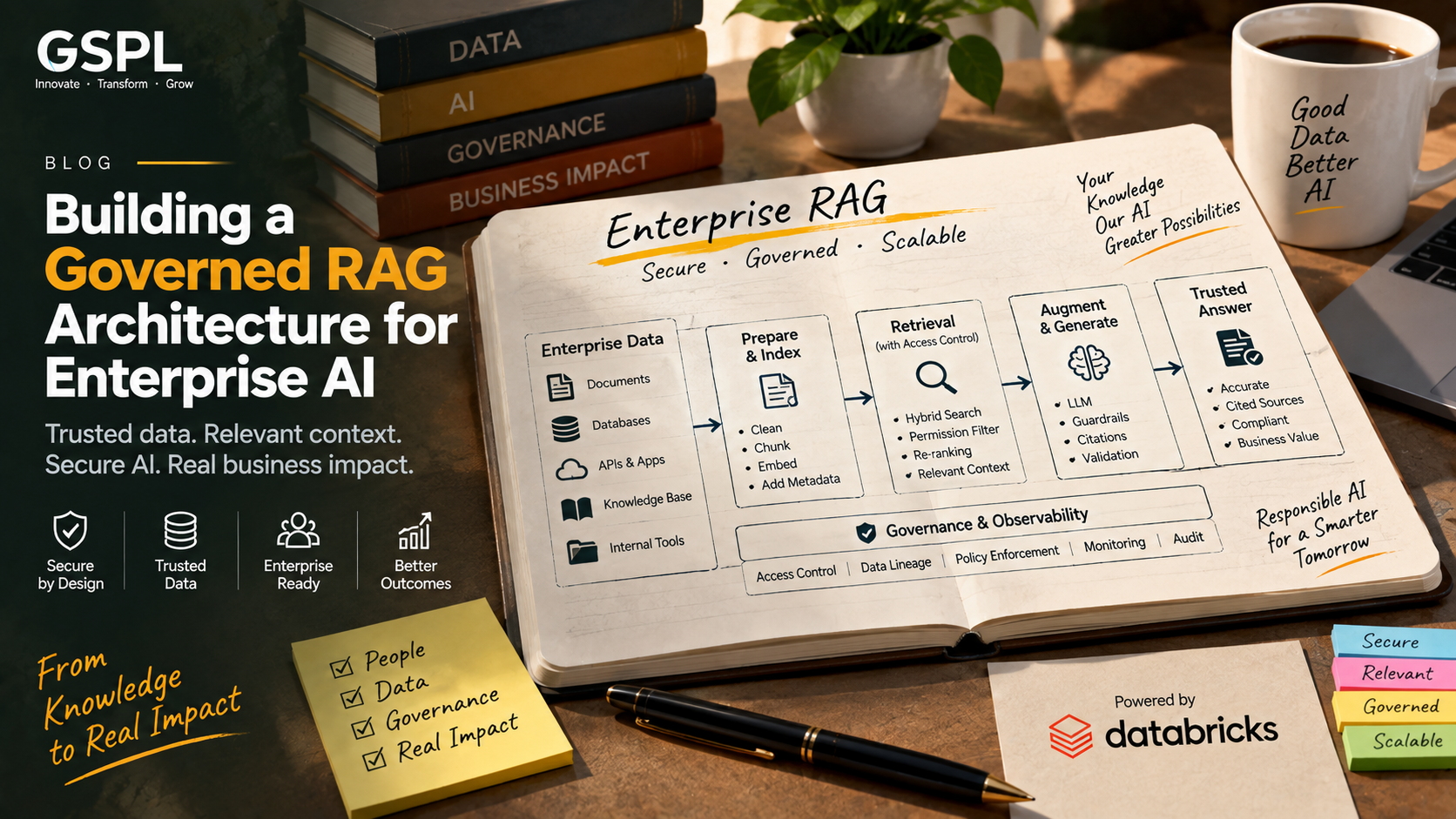
The RAG Promise—and Its Pitfalls
Retrieval-Augmented Generation (RAG) has become the go-to pattern for grounding LLMs in enterprise knowledge. By retrieving relevant documents before generating responses, RAG systems reduce hallucinations and provide source-backed answers. However, production RAG at scale introduces governance challenges: data lineage, access control, audit trails, and regulatory compliance.
The Four Pillars of Governed RAG
1. Source Authentication and Access Control
Every document ingested into your vector store should carry identity metadata: source system, owner, sensitivity level, and permitted user groups. Implement role-based retrieval filters so users only receive context from documents they're authorized to access.
2. Lineage and Auditability
Log every query, retrieval result, and generated response with timestamps and user IDs. Store chunk IDs alongside answers so you can trace any output back to its source document. This is critical for compliance audits and trust verification.
3. Content Filtering and Sanitization
Before embedding, apply PII detection, profanity filters, and business rule validators. Redact sensitive fields (SSNs, credit cards) or route them to secure enclaves. Post-generation, scan outputs for leakage or policy violations before returning to users.
4. Version Control and Freshness Guarantees
Documents change. Maintain versioned embeddings and refresh policies. Tag each chunk with an ingestion timestamp and re-embed on a schedule. Implement TTLs so stale knowledge doesn't mislead users.
Reference Architecture
Ingestion Layer
- • Source connectors with OAuth/API key rotation
- • Document parser with metadata extraction
- • PII scanner and redaction engine
- • Chunking service with overlap strategy
Storage Layer
- • Vector database (Pinecone, Weaviate, or Databricks Vector Search) with namespace isolation
- • Metadata store (PostgreSQL/MongoDB) for lineage
- • Object storage (S3/ADLS) for raw documents
Retrieval Layer
- • Query router with intent classification
- • Embedding service (OpenAI, Cohere, or self-hosted)
- • Hybrid search (dense + sparse) with re-ranking
- • Access control filter injected at query time
Generation Layer
- • LLM gateway (Azure OpenAI, AWS Bedrock, Databricks)
- • Prompt template manager with version control
- • Output validator and citation formatter
- • Response cache for cost optimization
Critical Implementation Patterns
Query-Time Access Control
Instead of duplicating vector indexes per user, inject metadata filters at retrieval time. Pass user roles/groups as filter predicates to your vector DB. This scales to thousands of permission groups without index explosion.
Fallback and Guardrails
When retrieval returns no results or low-confidence chunks, don't hallucinate. Return a structured "insufficient context" response with suggestions for refining the query. Implement confidence thresholds and keyword blocklists.
Continuous Evaluation
RAG quality degrades as documents grow. Run nightly eval sets: precision@k for retrieval, faithfulness scores for generation, and user feedback loops. Alert on metric drops and retrigger embeddings when needed.
Observability and Ops
Deploy OpenTelemetry instrumentation across all layers. Track latency, token usage, cache hit rates, and retrieval cardinality. Export traces to a unified platform (Databricks Lakehouse, Datadog, Grafana) for root-cause analysis. Monitor embedding drift and vector store freshness as first-class metrics.
Regulatory and Compliance Considerations
For GDPR/HIPAA workloads, implement right-to-be-forgotten by deleting vectors and metadata on request. Use encrypted embeddings or confidential compute enclaves for sensitive data. Maintain retention policies aligned with legal holds.
Document your RAG pipeline in a Model Card or System Card: training data sources, embedding models, LLM versions, and known limitations. This is increasingly required for AI transparency regulations.
The Path Forward
Governed RAG isn't a one-time build—it's an operational discipline. As LLMs evolve and enterprise knowledge grows, your RAG system must adapt with versioned pipelines, automated testing, and continuous governance enforcement.
Start small: pick a single use case, instrument it thoroughly, and prove compliance before scaling. The enterprises that win with RAG will be those that treat governance as a feature, not an afterthought.
Ready to Build Production-Ready RAG?
GSPL specializes in designing governed RAG architectures on Databricks, Azure, and AWS. We help enterprises balance innovation with compliance through secure, auditable AI systems.
Schedule a Consultation