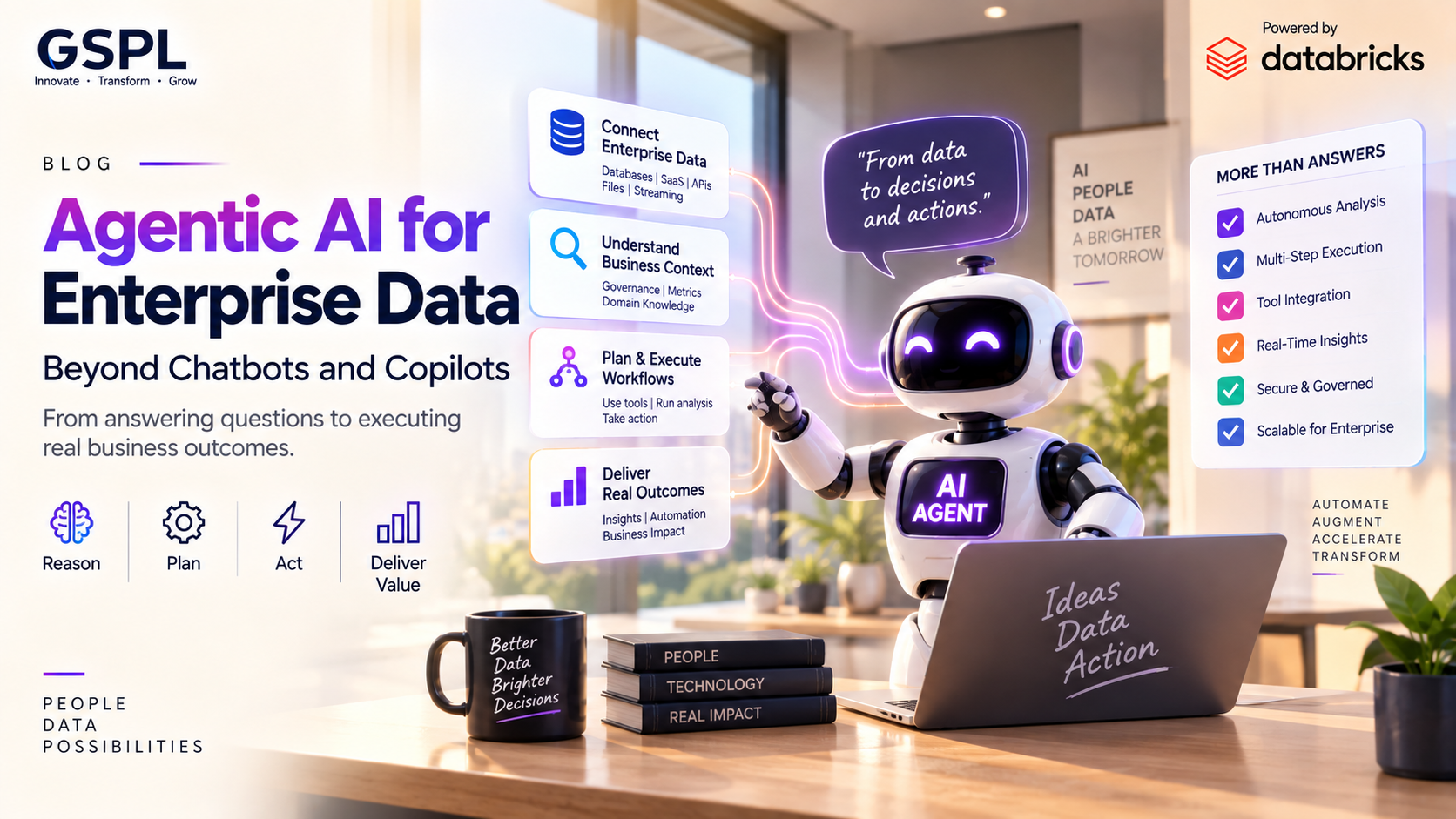
Enterprise AI is undergoing a fundamental architectural shift. While first-generation systems focused on conversational interfaces and assisted workflows, emerging agentic AI platforms can reason over enterprise data, execute multi-step workflows, use tools autonomously, and drive business outcomes within governed boundaries.
Executive Summary
- •The evolution: Enterprise AI is moving from chatbots (conversation) to copilots (assistance) to agentic systems (autonomous goal-directed workflows with tool use and multi-step reasoning).
- •Platform example: Databricks Genie Code Agent mode demonstrates this shift — planning workflows, discovering data, executing code, using tools, and recovering from errors while respecting governance boundaries.
- •Architecture requirement: Enterprise agents require more than LLMs — they need data access, tool integration, business context, memory, orchestration, observability, and comprehensive governance frameworks.
- •Governance imperative: Agentic systems introduce new risk surfaces requiring runtime governance covering agent behavior, tool access, API usage, cost controls, and human approval workflows.
The Evolution: From Conversation to Action
First-generation enterprise AI systems were primarily conversational. Employees could query chatbots for information, summarize documents, or receive task assistance. These excelled at single-turn interactions but struggled with complex, multi-step workflows.
AI copilots represented the second generation — suggesting code completions, summarizing meetings, generating SQL queries, and providing contextual assistance. However, copilots primarily assist humans rather than executing workflows independently.
Agentic AI represents the third evolutionary stage: systems that pursue business objectives through multi-step reasoning, autonomous tool use, workflow execution, result evaluation, and error recovery — all within governed boundaries.
| Capability | Chatbot | Copilot | AI Agent |
|---|---|---|---|
| Answers questions | ✓ | ✓ | ✓ |
| Plans multi-step tasks | No | Some | ✓ |
| Uses tools autonomously | No | Some | ✓ |
| Executes workflows | No | Assisted | ✓ |
| Recovers from failures | No | Limited | ✓ |
| Governance requirement | Standard | Important | Critical |
Chatbots communicate. Copilots assist. Agents act.
What Defines Agentic AI
Agentic AI systems pursue goals through autonomous multi-step workflows:
- Understand business objectives from natural language
- Plan multi-step approaches to achieve objectives
- Discover relevant data across enterprise systems
- Use appropriate tools (APIs, databases, functions)
- Execute actions autonomously within governance boundaries
- Evaluate results against expected outcomes
- Adjust and retry when initial attempts fail
- Seek human approval for high-risk operations
- Deliver business outcomes rather than just information
Enterprise Agent Architecture
Production-grade agentic systems require more than an LLM:
- Foundation model: LLM for reasoning and language understanding
- Enterprise data access: Governed connections to databases, lakehouses, APIs
- Tool ecosystem: Functions and services the agent can invoke
- Business context: Domain knowledge, metrics, organizational semantics
- Workflow orchestration: Multi-step process coordination and error handling
- Observability: Monitoring, logging, and tracing
- Security controls: Authentication, authorization, data access enforcement
- Governance frameworks: Policy enforcement, compliance, audit trails
- Approval workflows: Human-in-the-loop for high-risk operations
Databricks extends Unity Catalog toward providing semantic context through business-oriented Domains, governed Metrics, and capabilities for governing models, agents, tools, and Model Context Protocol (MCP) servers.
Enterprise Use Cases
Customer Service Intelligence
Agents synthesize customer profiles, order history, support tickets, and delivery status to diagnose issues and recommend solutions — reducing resolution times while maintaining quality.
Sales Analytics
By analyzing CRM activity, pipeline data, and revenue metrics, agents identify opportunities, flag at-risk accounts, and support forecasting workflows.
Data Engineering Workflows
Databricks Genie Code Agent mode discovers datasets, generates pipeline code, tests transformations, investigates failures, and assists with migration projects.
Financial Analysis
Agents analyze financial datasets to detect anomalies, compare period-over-period performance, and generate investigation summaries — subject to approval workflows for high-impact actions.
The Governance Imperative
Greater autonomy creates greater risk. Enterprise agent architecture must address:
- Access controls: What data can agents access based on user permissions?
- Action boundaries: What operations can agents perform autonomously?
- Tool governance: Which APIs and services can agents invoke?
- Approval workflows: Which actions require human authorization?
- Audit requirements: How are decisions and actions logged?
- Cost controls: What resource consumption limits apply?
- Error handling: What happens when agents make mistakes?
Databricks Unity Gateway extends governance into runtime agent interactions involving models, MCP servers, and tools — providing access controls, routing policies, guardrails, and observability.
Controlled Autonomy: Human-in-the-Loop
Agentic doesn't mean fully autonomous. Enterprise systems benefit from graduated independence based on risk:
- Low-risk: Agent executes autonomously (data queries, analysis)
- Medium-risk: Agent recommends, human approves (pipeline deployment)
- High-risk: Agent analyzes, human decides and executes (financial transactions)
Five Principles for Enterprise Agents
1. Start With Measurable Outcomes
Identify concrete problems: "Reduce customer service resolution time by 30%" or "Decrease pipeline troubleshooting by 50%." Then determine if an agent is appropriate.
2. Provide Reliable Context
Agents need trusted information with clear business semantics. Poor data quality produces unreliable outcomes. Invest in data governance and metadata management.
3. Follow Least-Privilege Principles
Agents should have only minimum required access. An agent analyzing customer data shouldn't modify production systems or access unrelated sensitive information.
4. Control High-Risk Operations
Require approval workflows for financial transactions, sensitive data access, production infrastructure changes, and destructive operations.
5. Measure Continuously
Evaluate accuracy, task completion rates, tool-call success, latency, cost, failure rates, and business impact. Agent evaluation should be part of the production lifecycle.
Conclusion: Governed Agentic AI
Enterprise AI is transitioning from systems that respond to questions toward systems that pursue goals through autonomous workflows. This represents significant opportunity: agents can discover information, reason over data, use tools, and coordinate complex business workflows.
However, autonomy without governance creates unacceptable risk. The future belongs to governed agentic AI — systems combining capable models with trusted enterprise data, clear business context, secure tool access, comprehensive observability, and appropriate human oversight.
The objective is identifying workflows where intelligent automation delivers measurable value and implementing them on architectures that are secure, governed, observable, and scalable.
Ready to Explore Agentic AI for Your Enterprise?
G S Pvt Ltd helps organizations build modern data and AI platforms that bring together enterprise data, AI agents, automation, analytics, and governance — enabling businesses to move from AI experimentation to production-ready intelligent workflows.
Schedule a Consultation →